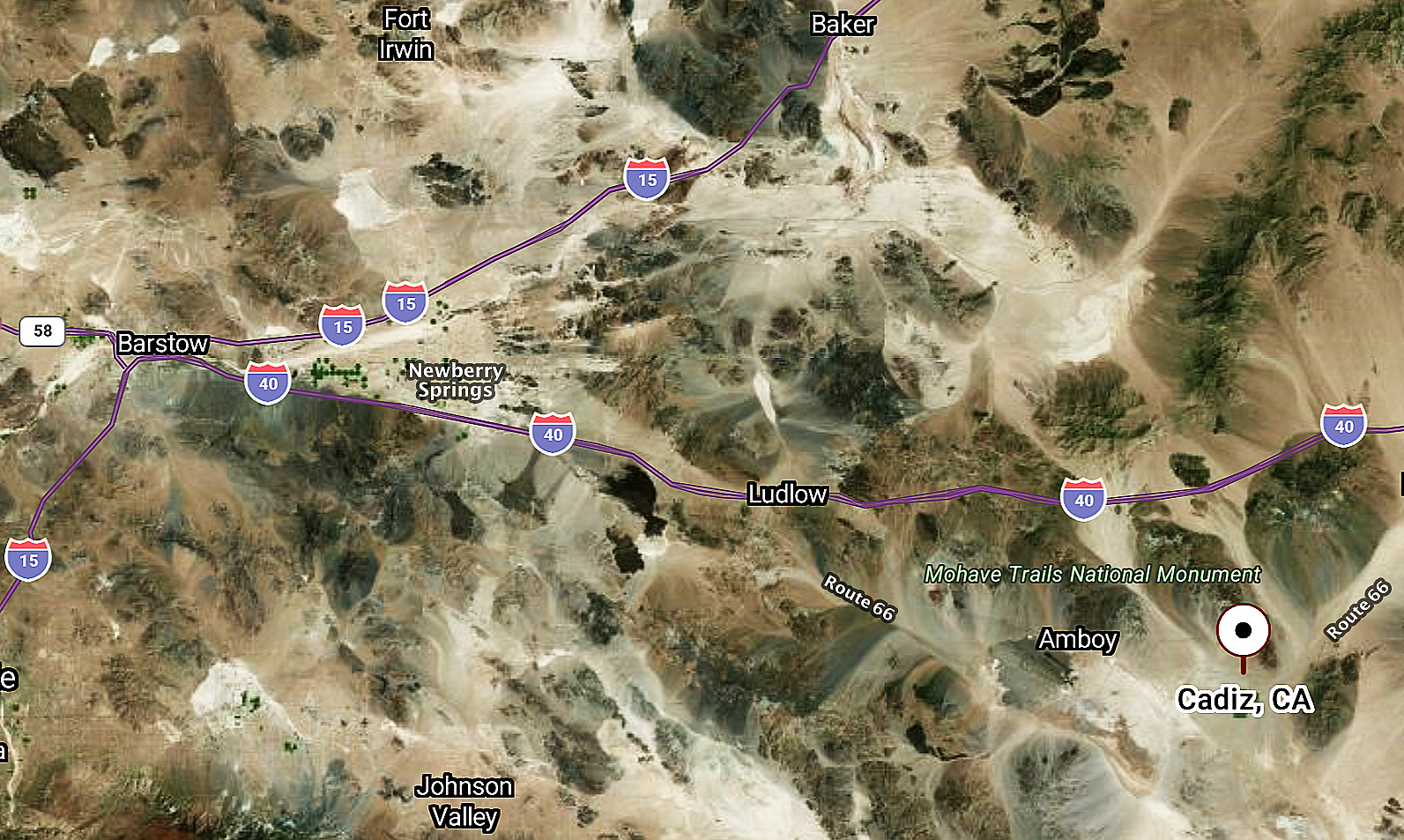
Click to enlarge.
Reasons The Cadiz Northern
Pipeline May Not Happen
 Posted: November 6, 2025
Newberry Springs Community Alliance
Opinions by Tëd Stimpfel
This is a long blog for those who want
knowledge about the controversial
Cadiz water project.
The topic of the Cadiz, Inc. water project came up for initial
Newberry Community Services District's discussion at the October 2025,
monthly meeting.
There was the expected soapbox donkey-talk coming from
Director Jack Unger on various topics. However, there was a single, surprisingly
long spiel from Director Robert Springer on Cadiz.
Admitting that he had missed the Chamber's Cadiz community
meeting, Springer acknowledged that he would need to learn more about it.
Nonetheless, he spoke at great length that Newberry would be foolish if it
didn't grab the Cadiz water that is being offered.
What Director Springer failed to ask is where the water
would come from, where it would go, our cost, and the environmental cost
to the water's source.
This writer has been closely following the Cadiz water
project for 13 years. I am totally opposed to it. Not that I am opposed to
Newberry acquiring water, but the Cadiz project is filled with lies and
misrepresentations. I have learned not to believe or expect anything that
Cadiz, Inc. says.
After attending the Chamber's Cadiz water meeting, I was hearing
people loving the project and believing the spin that Cadiz, Inc.'s CEO,
Susan Kennedy, gave to the audience. Well, Kennedy intentionally omitted a great
deal of basic information.
Knowing a little bit about the project, I recognized fear and
panic in Kennedy. The project lacks funding, and Kennedy immediately needs
large government grants.
To acquire those grants, Kennedy needs disadvantaged communities
(and there are only a few along the pipeline) to sign a Memorandum of Understanding
(MOU) to support the requirements of the federal grants.
Susan Kennedy is the CEO of some major high-ticket projects.
Yet, she has made two long drives to tiny Newberry Springs to lobby for support.
Cadiz, Inc. is in trouble.
Kennedy gave no promise as to the amount of water planned
for Newberry Springs. That is because Kennedy does not know herself. What she
wants for now is just our MOU. She will make promises that may not be kept.
Truthfully, I don't believe that promises mean anything to her. It's purely
business.
There won't be much water directed to Newberry. The pipeline
is targeting urban sprawl around Barstow's BNSF BIG project and the Victor Valley
areas that can spend top dollar for the water. Any promised water for Newberry
Springs will be extremely limited. Newberry is falling into a trap.
Cadiz, Inc. claims that it can sustainably extract 50,000 acre
feet of water a year from Fenner Gap which is near Cadiz, California. The pipeline
going through Newberry Springs, called the Northern Pipeline, can allegedly handle
30,000 acre-feet per year.
Some hydrologists' studies place the sustainable amount of water
that can be safely extracted at closer to 2,000 to 10,000 acre-feet per year. If
a court rules at the lower level (and not 50,000 AFY) and subtracts the water for
the 3,500 acres of farming that Cadiz, Inc. does at Cadiz, California, there might
not be enough water in the pipeline for the pumping stations.
Of course, Susan Kennedy didn't reveal any of this potential
collapse to us.
Newberry Springs is currently still under court adjudication to
force the needed sustainability of our water supply. Uncontrolled farmer overdrafting
of water had to be addressed. Fortunately, Newberry Springs, like Cadiz, has
lots of water, but it is deep.
We do not need the Cadiz water. We have an adequate supply if
we don't over-extract for farming.
The proposed Cadiz water extraction from the Fenner Gap will
cause devastation to that region's 1,000 square mile environment.
To summarize a huge package of information, below are bullet
points to give you an understanding of some of the many elements involved in
the Cadiz, Inc. pipeline project. While far from being complete, it is an
educational summary. Let's see if I can make you a little skeptical of the
project. I believe that the project is a sham.
Possible Roadblock to the Cadiz North Pipeline
There is a possible blockage to the Cadiz, Inc.'s Northern Pipeline from going operational. This is rooted in a combination of ongoing federal environmental review requirements and state-level land/lease decisions.
The obstacles to the pipeline's operation center on the permits and rights-of-way required to repurpose the existing gas pipeline for water transport, particularly where it crosses public lands.
Primary Current Obstacles to the Pipeline Going Operational
-
Federal Environmental Review Requirement
The critical roadblock is the process required by the Bureau of Land Management (BLM) for using the pipeline to transport water.
- Vacated Permit: In September 2022, a federal court vacated (nullified) the permit (right-of-way) that Cadiz had been granted in the final days of the previous administration to convert a portion of the pipeline for water transport.
- Voluntary Remand: The court ruling was based on the BLM's own request for a voluntary remand, acknowledging that the agency had failed to conduct the required environmental analysis under the National Environmental Policy Act (NEPA) and the National Historic Preservation Act (NHPA).
- Current Status: The BLM must now conduct a legally adequate environmental review (potentially an Environmental Assessment or an Environmental Impact Statement) and tribal consultation before it can approve a new right-of-way for water conveyance.
- Possible Block: If the full environmental review finds that the conversion and operation of the pipeline for water would cause significant, unmitigated environmental or cultural impacts - especially to the Mojave Trails National Monument and surrounding lands - the BLM could be legally constrained from granting the necessary permit, effectively halting the pipeline.
-
State Lands Commission Decision
A separate, significant setback occurred at the state level:
- Lease Termination: In December 2024, the California State Lands Commission voted to terminate a long-term right-of-way lease for a portion of the northern pipeline that crosses state lands.
- Decommissioning Ordered: The Commission ordered the former owner (El Paso Natural Gas Company) to begin the decommissioning process and ultimately remove the pipeline from state lands.
- Possible Block: This decision creates a gap in the pipeline's route, making it impossible to transport water along the full Northern Pipeline without either successfully appealing or reversing the Commission's decision, or having the BLM proceed with the removal (decommissioning) process.
Federal & State Conclusion
Possible stoppage of the pipeline from becoming operational can come from environmental and conservation groups, as well as state and federal agencies, focusing on two key areas:
- Ensuring the BLM's current NEPA review is robust and demonstrates that the pipeline's conversion for water conveyance would violate federal environmental laws.
- Defending the State Lands Commission's decision to terminate the pipeline's lease and require its removal from state lands.
Environmental and Tribal Opposition
The potential environmental impacts of the Cadiz water project are the central arguments used by opponents and have been the focus of years of legal challenges, which resulted in the recent federal and state setbacks for the pipeline.
The Primary Environmental Concerns
-
Water Sustainability and Aquifer Overdraft
The most fundamental dispute is over whether the proposed water extraction is sustainable and will avoid aquifer overdraft.
- Unsustainable Pumping Rate: The Cadiz project proposes to extract a large volume of groundwater annually over 50 years. Opponents, citing independent federal scientists from the U.S. Geological Survey (USGS), argue that this extraction rate vastly exceeds the natural recharge rate of the aquifer. Some federal scientists previously estimated the project would extract up to 25 times more groundwater than is naturally recharged.
- The Recharge Debate: Cadiz, Inc. and its consultants counter with their own studies, which use a different modeling approach to estimate a higher average annual recharge rate, claiming the water would otherwise be lost to evaporation at dry lakes. Opponents maintain that relying on this "new" science to justify such a high pumping rate is environmentally unsound.
- The Risk: Unsustainable extraction would lead to a long-term decline in the regional water table, essentially "mining" the desert's finite water supply.
-
Harm to Fragile Desert Ecosystems
The drop in the water table is feared to have devastating consequences for the surrounding protected lands and the unique species they host.
- Drying Springs and Seeps: A major concern is that the high-volume pumping will drain the ancient aquifer, which is hydraulically connected to surface water sources like springs and seeps in the surrounding mountains and nearby public lands, including the Mojave Trails National Monument and Mojave National Preserve.
- Impact on Wildlife: These desert springs are critically important, life-sustaining oases for iconic desert wildlife, especially during drought conditions. The loss of this surface water threatens:
- The threatened desert tortoise.
- Desert bighorn sheep, which rely on the springs for survival.
- The Mojave fringe-toed lizard and other sensitive desert flora and fauna.
-
Water Quality Concerns (Hexavalent Chromium)
Concerns have been raised about the water quality itself, which could pose a risk to the Southern California communities intended to receive the water.
- Hexavalent Chromium • Cr (VI): Scientific testing has shown that the groundwater contains the toxic chemical hexavalent chromium, a known carcinogen, which occurs naturally in the desert's geological formations.
- Health Risk and Treatment Cost: Opponents stress that this necessitates extensive (and expensive) treatment to meet California's stringent drinking water standards. While Cadiz Inc. has stated they will treat the water at their expense, the presence of the contaminant remains a significant concern for environmental and ratepayer advocates.
The ongoing federal environmental review by the BLM will be the next major battleground where these scientific and environmental arguments will be assessed to determine the fate of the pipeline's operational permit.
Tribal Opposition: A Major Legal and Cultural Force
The opposition from Native American Tribes has been one of the most powerful and successful forces against the Cadiz project, leading to a major legal victory that currently blocks a key part of the project's infrastructure.
-
Core Issues and Stakeholders
- Cultural and Sacred Sites: Numerous California desert tribes, including the Chemehuevi, Mojave, and Southern Paiute, strongly oppose the project, asserting that the pumping would deplete the water sources vital to their traditional territory, including the Salt Song Trail and sacred springs in the Old Woman Mountains. The project is viewed as a threat to their cultural survival and sacred ancestral lands.
- Lack of Consultation: A central legal argument was that the federal government failed to conduct the legally required government-to-government consultation with the impacted Tribal nations before granting key permits.
- Major Opponents: The Native American Land Conservancy (NALC), a nonprofit organization dedicated to preserving sacred lands, has been a leading plaintiff in the legal battles, along with the National Parks Conservation Association (NPCA). The National Congress of American Indians (NCAI) has also adopted a resolution opposing the project.
-
Recent Legal Victory
- Pipeline Permit Vacated: As previously stated, in September 2022, a federal court judge vacated a crucial right-of-way permit that the Bureau of Land Management (BLM) had granted to Cadiz Inc. This permit would have allowed the company to convert an idle, existing natural gas pipeline into a water pipeline.
- The Rationale: The court sided with the plaintiffs (NALC, NPCA, and the Biden administration's BLM) who argued that the prior administration had fast-tracked the approval in December 2020 without conducting the necessary environmental or historic preservation analysis, which includes consultation with Tribal nations regarding sacred sites.
- Current Status: The court ruling sends the decision back to the BLM for a full environmental and historic preservation review, a process which will likely require robust tribal consultation. This has placed a significant, immediate hurdle in front of the project's development.
-
Cadiz Inc.'s New Strategy
In response to the legal and regulatory setbacks, Cadiz Inc. has recently pivoted its strategy to include a unique financial partnership:
- Tribal Investment Proposal: Cadiz Inc. has secured a letter of intent from one Northern California Native American tribe, the Lytton Rancheria, to potentially invest up to $51 million in the project (rebranded as the Mojave Groundwater Bank). Cadiz has stated it is in talks with other tribes as well.
- The Conflict: This new funding approach creates a complex political dynamic, as some tribes are now partners in the project, while the tribes and organizations in the Mojave Desert region remain staunchly opposed to the water extraction itself, viewing the financial partnership as a distraction from the fundamental environmental damage.
The opposition from the Mojave Desert tribes remains active and is tied to the fundamental issue of protecting the ecological and cultural integrity of their ancestral lands.
California State Lands Commission and State Law (SB 307)
The California State Lands Commission (SLC) is a critical player in the fate of the Cadiz project, especially regarding its state-level permits.
-
The California State Lands Commission (SLC) Decision
The SLC has jurisdiction over a small, but vital, portion of the 220-mile northern pipeline right-of-way (approximately one mile of state-owned land).
- Pipeline Lease Terminated: In December 2024, the SLC effectively issued a major setback by terminating the long-term pipeline right-of-way lease that was previously held by the pipeline's original owner, El Paso Natural Gas Company.
- Issuance of Caretaker Lease: Instead of granting Cadiz a lease for water conveyance, the SLC issued a 3-year caretaker lease to the original owner (El Paso Natural Gas Company) to simply maintain the pipeline in an idle status. This action prevents Cadiz from immediately converting the pipeline to transport water.
- Decommissioning Requirement: The caretaker lease requires a decommissioning plan and application to be submitted by December 2025, indicating the SLC is moving toward winding down the pipeline's presence on state land, not facilitating its conversion for water use.
-
The Impact of State Law (SB 307)
The SLC's decision is heavily influenced by a major state law passed in 2019: Senate Bill (SB) 307. This is the bill that I questioned Susan Kennedy about at the October 20, 2025, community meeting. Kennedy ad-libbed as though she was unfamiliar with it.
- The Mandate: SB 307 prohibits the transfer of water from groundwater basins in the southeastern Mojave Desert, including the Cadiz Valley, unless the State Lands Commission (in consultation with the Department of Fish and Wildlife and the Department of Water Resources) can independently find that the water removal "will not adversely affect the natural or cultural resources" in the region.
- A Near-Insurmountable Hurdle: This law requires an independent, transparent scientific review to prove no adverse impact - a standard widely considered to be an extremely high bar for a massive groundwater extraction project in a fragile desert ecosystem.
In summary, the Cadiz project faces a one-two punch in California:
- Federal Level: A court has blocked the use of a key portion of the pipeline across federal lands (BLM).
- State Level: The SLC has terminated the long-term lease for the pipeline across state land and is required by law (SB 307) to conduct a highly skeptical review before any water export could be authorized.
Detailed Environmental Claims Against the Project
The core of the opposition to the Cadiz Water Project centers on the potential for catastrophic environmental damage due to what critics argue is unsustainable water extraction, despite the company's claims of "conservation."
-
The Core Scientific Dispute: Groundwater Overdraft
- Cadiz's Claim: Cadiz Inc. has argued that their proposed pumping rate of 50,000 acre-feet per year (AFY) is equal to or less than the natural recharge of the aquifer and/or water that would otherwise be lost to evaporation.
- Opponents' Claim (Independent Scientists/USGS): Multiple independent hydrologists, including former U.S. Geological Survey (USGS) scientists and the Pacific Institute, have concluded that Cadiz's estimates vastly overstate the recharge rate.
- Unsustainable Pumping: Critics argue that the actual recharge is significantly lower (with some estimates as low as 2,000 to 10,000 AFY). Pumping 50,000 AFY would constitute "groundwater mining" - actively draining the aquifer's ancient, non-renewable storage.
- Irreversible Damage: One analysis suggested that even under the most optimistic opposition-cited recharge rate, the basin would take approximately 30 years to recover after the 50-year project ends, and under lower estimates, it would effectively never recover, leading to permanent depletion.
-
Threat to Desert Springs and Water-Dependent Ecosystems
The main consequence of dropping the water table would be the drying up of fragile, life-sustaining desert springs.
- Bonanza Spring: This is the most critically cited feature. Bonanza Spring is the largest and arguably most important wetland in a 1,000 square-mile area.
- The Connection: Multiple peer-reviewed studies funded by opponents have used isotope data and chemical analysis to conclude that Bonanza Spring is fed by the regional groundwater that Cadiz intends to pump.
- The Risk: The dropping water table would create a "cone of depression" in the aquifer, which opponents contend would reduce groundwater levels sufficiently to dry up the spring, destroying the entire ecosystem it supports.
-
Impact on Iconic Desert Wildlife
The loss of water from desert springs would directly threaten several sensitive species in the surrounding Mojave Trails National Monument and the Mojave National Preserve.
- Desert Tortoise (Threatened Species): The project's construction and its indirect impact on vital habitat and water sources pose a significant threat.
- Desert Bighorn Sheep: These animals rely on the rare, perennial water sources like Bonanza Spring for survival in the arid environment. Losing the springs would decimate local herds.
Cadiz Inc.'s New Strategy: The Mojave Groundwater Bank
Cadiz Inc. has recently pivoted its strategy and project structure, rebranding the project as the Mojave Groundwater Bank and focusing on new partnerships and financing methods following legal and regulatory setbacks on the original pipeline plan.
New Structure and Key Partnerships
- Project Entity: The project will be constructed, owned, and operated by a special-purpose entity, the Mojave Water Infrastructure Company, LLC (MWI).
- Tribal Partnership: Cadiz has announced a landmark partnership with the Lytton Rancheria of California, a federally recognized Native American tribe.
- The Lytton Rancheria has executed a definitive agreement for an investment of up to $51 million in the MWI entity, the first tranche of the project's equity financing.
- The goal is for tribes to hold a majority ownership stake (51% of cash flows from water storage sales/banking operations) in the project.
- Water Banking Focus: The new structure emphasizes its role as a Groundwater Bank with two main functions:
- Water Supply: Delivering water to Southern California communities.
- Water Storage: Offering up to 1 million acre-feet of underground storage capacity for imported water (e.g., from the Colorado River) for water districts to bank and withdraw during droughts.
(Note: The Lytton Rancheria of California Indians and the naive eastern investors may soak up this fallacy. Naturally, Cadiz, Inc. wants the pipeline construction profits. But, how soon will the Colorado River have so much water that other states, with priority water rights, don't want the water? When can Cadiz, Inc. take Colorado River water and bank it under their land? This banking scheme has Zero chance!)
Lytton Rancheria's Reasons for Investment
The Lytton Rancheria's primary motivation is to secure a seat at the table in shaping the future of water management and to advance Tribal sovereignty over critical infrastructure and resources.
Core Motivations for the Investment
- Influence and Ownership: The partnership allows the Lytton Rancheria to convert their investment into a membership interest in the MWI entity. By owning a majority stake, the tribes gain 'control' over the direction and operation of the project to ensure a sustainable, responsibly managed water source.
- Stewardship and Environmental Justice: The tribe views the investment as a way to fulfill their role as stewards of the land and to focus the project on delivering water to underserved, disadvantaged, and tribal communities - aligning with environmental justice principles.
- Water Security and Leverage: The ownership stake provides a long-term strategic asset, giving the tribes 'leverage' to trade and exchange water within California's complex water network, thereby enhancing their water security.
The investment is the first major investment by a Native American Tribe in large-scale water infrastructure off tribal lands in U.S. history. This Northern California tribe wants the southern tribes to trust them. They don't. It is not the Lytton Rancheria's ancestral turf.
Pipe Dream
In my opinion, I believe that the Cadiz, Inc.'s 'Northern Pipeline' has little chance of success. I believe that Cadiz, Inc. must know it now and is pivoting to water banking, which has even less chance of success.
The Lytton Rancheria investing in Cadiz, Inc., expecting acquisition of Colorado River water, is nuts. Meanwhile, Cadiz, Inc. is trying to use disadvantaged communities along the pipeline to secure federal grants.
There are additional roadblocks for the pipeline that I am not writing about. At least, not at this time.
🌵
Should you favor more news blogs,
please visit and LIKE our Facebook site.
Click here to read, "Like,"
comment, or share on:

|
• • •
Home page: http://NewberrySpringsInfo.com
Personal opinions © 2025 Tëd Stimpfel. All rights reserved.